
Case study
CinerideAI
A film production budget back office, with AI that matches incoming documents against the budget and proposes sourced adjustments.

- Year
- 2026
- Services
- Technologies
- React, Vite, TypeScript, Express, PostgreSQL, Prisma, BullMQ, Redis, OpenAI, MinIO, Docker
01 / Context
Overview
Cineride Log handles transport for film shoots in Morocco, with its own vehicles, drivers and suppliers. For its budget team, we designed a three-layer platform, running from the back office where each production's budget is built to routines that keep comparing it with the documents received. That budget moves throughout the shoot, so the AI proposes sourced adjustments, which only the budget team can apply.
02 / Starting point
What the project had to solve
The documents that back up the budget arrive out of order, by email or as attachments, and sometimes late. The same person can also appear under several spellings, so attaching a document to the right budget line takes far more than a simple search. The tool therefore had to propose corrections without ever applying them itself, because responsibility for the figures stays with the budget team.
03 / Scope
Scope
We designed and built the whole platform. The first layer is the back office, which handles budget construction, the reference lists of vehicles, drivers and suppliers, and the follow-up of each production. The second reads incoming documents and prepares the proposals, while the third runs routines that watch the budget without anyone having to trigger them.
04 / Decisions
Decisions
Every AI proposal states its source, its confidence level and the reason for the change, and it stays a draft until a person approves it. The AI can only propose changes to a closed list of fields, and a field carries only one pending proposal at a time, so the review queue never contradicts itself. A rejected value is remembered so it doesn't come back, and when two documents disagree, the most recent one prevails. Changes to amounts are added to the history without ever overwriting it, and an extraction only goes into service once it reaches a precision threshold measured on real documents replayed through it.
05 / Build
What we built
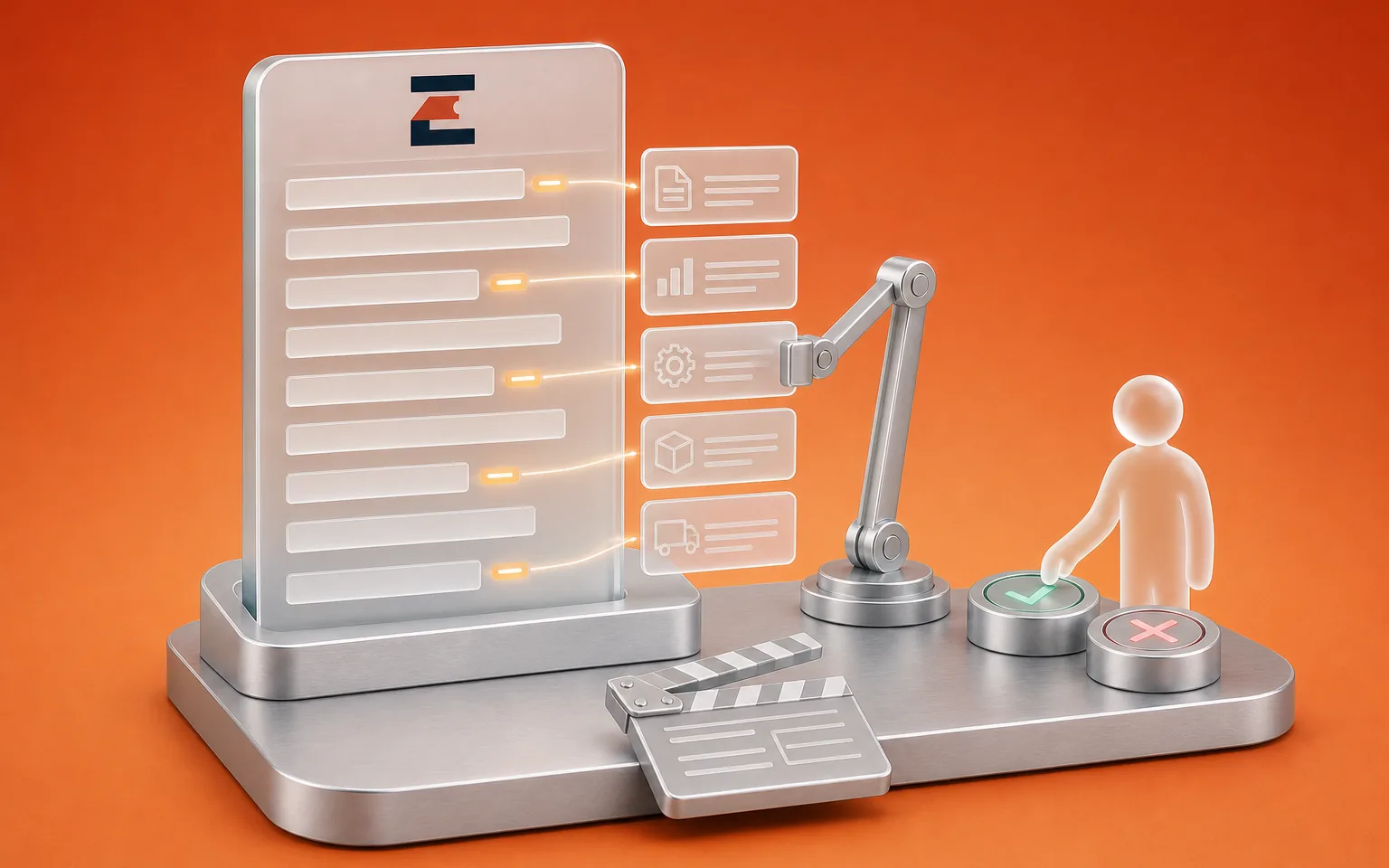
In the back office, the budget team builds a production's budget line by line from its reference lists, then tracks its costs as the shoot goes on, to optimise them line by line. Documents arrive by upload or from a monitored mailbox, and the AI sorts them, extracts what matters and compares it with the state of the budget. The AI changes nothing itself, so its proposals wait in a review queue, where the team approves or rejects them one by one. Each document also has its own conversation thread, where the AI can be asked about its content.
06 / Technology and integration
Technology and integration
The interface is built in React with Vite and TypeScript. The server, on Express and TypeScript, relies on PostgreSQL with Prisma, and every document job goes through a BullMQ task queue on Redis, so one long document doesn't hold up the others. OpenAI models read the documents, and incoming files are kept in MinIO object storage. The whole system runs in Docker containers, with separate permissions for each user role.
07 / Expected results
The expected results
Each production's budget is built in a single tool, and its costs are tracked line by line so they can be optimised.
Every document received is matched against the budget, and every gap leads to a sourced proposal.
The budget team approves or rejects every proposal, and nothing is applied without it.
Routines watch the budget continuously and flag a gap as soon as a document arrives.
Related pages
Let's discuss your priorities
A comparable project in mind?
Tell us about your context, and we'll tell you how we would approach it.