
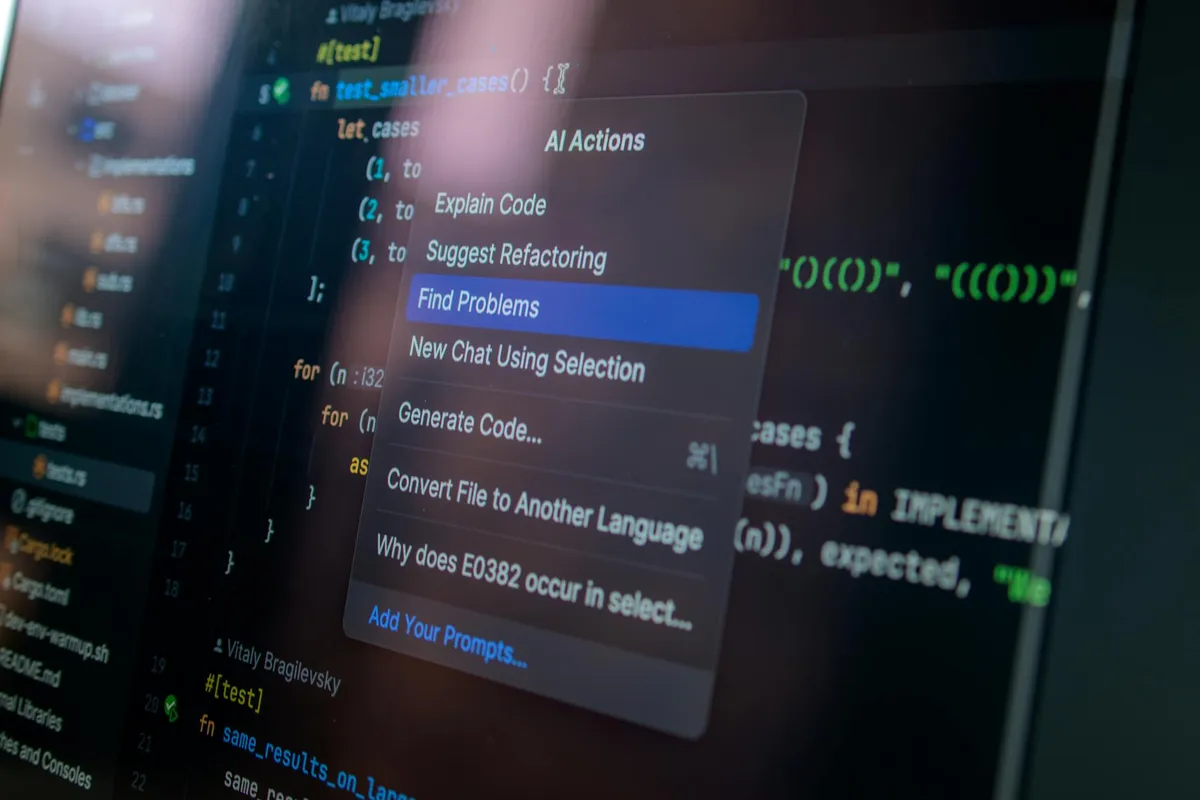
Google I/O 2026 was dominated by Gemini announcements, but a quieter demo caught developers' attention: AlphaEvolve. This new coding agent from DeepMind doesn't just generate code, it evolves it. By combining neural networks with evolutionary algorithms, AlphaEvolve represents a breakthrough in how AI can assist software development. Let's see how it compares to current leaders: GitHub Copilot and Cursor.
What AlphaEvolve Is
AlphaEvolve isn't a simple intelligent autocomplete. It's an autonomous agent that can:
- Understand an objective: You describe what the code should accomplish, not how to write it
- Generate variants: The agent produces multiple candidate implementations
- Evaluate and select: Via automated tests, benchmarks, or defined criteria, it eliminates inferior solutions
- Iterate: The best solutions mutate and recombine to produce new generations
The process directly mirrors biological evolution: variation, selection, reproduction. Except here, generations succeed each other in minutes, not thousands of years.
During the I/O demo, AlphaEvolve optimized a matrix sorting algorithm for TPU, exceeding Google engineers' manual implementations by 12% after 50 refinement generations. All in 47 minutes.
GitHub Copilot: The Ubiquitous One
GitHub Copilot remains the reference tool for most teams. Launched in 2021, it reached 1.8 million paying users in 2026 according to Microsoft figures.
Strengths
- Native integration: VS Code, JetBrains, Neovim, Visual Studio. Copilot is everywhere.
- Project context: With Copilot Workspace (GA since March 2026), the tool understands your entire codebase, not just the open file.
- Mature ecosystem: Abundant documentation, active community, third-party extensions.
Limitations
- Not truly agentic: Copilot suggests but doesn't drive. You remain the conductor.
- Limited context: Despite improvements, very large projects (over 500,000 lines) remain difficult to index effectively.
- Enterprise pricing: $39/month/user for Copilot Enterprise, roughly $470/year per developer.
Ideal For
Teams that want a discreet assistant integrated into their existing workflows without changing work habits.
Cursor: The AI-Native IDE
Cursor took a different approach: rather than integrating into an existing IDE, they rebuilt the editor around AI. A VS Code fork, Cursor adds capabilities that plugins can't offer.
Strengths
- Advanced contextual chat: Cursor indexes your entire project and enables conversations that understand global architecture.
- Multi-file editing: Request a refactoring touching 15 files, Cursor generates a coherent diff.
- Composer mode: Describe a complete feature, Cursor generates the necessary files.
Limitations
- IDE lock-in: You must abandon your current editor. For teams accustomed to IntelliJ or specific VS Code extensions, this is a barrier.
- Token consumption: Complex operations quickly consume credits. The Pro plan ($20/month) includes limited requests.
- Maturity: Younger startup, less track record on long-term stability.
Ideal For
Individual developers or small teams willing to switch IDEs to maximize AI assistance.
AlphaEvolve: The New Entrant
AlphaEvolve isn't publicly available yet. Technical preview will be reserved for Google Cloud partners during Q3 2026. But the announced specifications deserve attention.
What Sets It Apart
-
Evolutionary approach: Instead of predicting the "best" code, AlphaEvolve explores a solution space and converges toward optima through selection.
-
Self-verification: The agent writes tests to validate its own code, then uses those tests as a fitness function.
-
Optimization beyond correctness: Code shouldn't just work, it should be performant. AlphaEvolve explicitly optimizes latency, memory, or other target metrics.
-
Gemini integration: Built on Gemini 2.0, with access to 2-million-token long-context memory.
Anticipated Limitations
- Compute resources: The evolutionary approach requires hundreds of generations, thus thousands of inferences. Potentially high cost.
- Narrow use cases: Optimized for well-defined algorithmic problems, less suited to business code with fuzzy specifications.
- Availability: Google Cloud only, no local version.
Ideal For
Teams working on complex optimization problems (infrastructure, ML, critical systems) with Google Cloud budget.
Detailed Comparison
| Criterion | GitHub Copilot | Cursor | AlphaEvolve | |-----------|---------------|--------|-------------| | Type | Assistant | AI-native IDE | Evolutionary agent | | Autonomy | Low | Medium | High | | IDE Integration | Excellent | Own VS Code fork | Terminal/API | | Max Context | ~100K tokens | ~1M tokens | ~2M tokens | | Multi-file | Limited | Excellent | Excellent | | Auto-tests | No | No | Yes (native) | | Optimization | No | No | Yes (core product) | | Price | $19-39/month | $20/month | Unknown (cloud) | | Availability | GA | GA | Preview Q3 2026 |
Which Tool for Which Team?
Moroccan Startups and SMEs
Recommendation: Cursor or Copilot
For constrained budgets and teams of 2-10 developers, Cursor's cost-benefit ratio is unbeatable. If your team is heavily invested in the VS Code ecosystem with specific extensions, stick with Copilot.
At Claro Digital, we use Cursor for our internal AI transformation projects and Copilot for client projects where the IDE environment is mandated.
Infrastructure/DevOps Teams
Recommendation: AlphaEvolve (when available)
Automatic optimization of scripts, Kubernetes configurations, or CI/CD pipelines is an ideal use case for the evolutionary approach. Watch for the Q3 preview.
Enterprise Teams with Complex Stacks
Recommendation: GitHub Copilot Enterprise
Integration with GitHub Enterprise, compliance policies, and Microsoft support make Copilot the default choice for large organizations.
How to Evaluate for Your Context
Before choosing, answer these questions:
1. What's your current IDE?
- VS Code: All three options work
- JetBrains: Copilot only (or migrate to Cursor)
- Neovim/Emacs: Copilot only
2. What type of code do you write?
- Standard business code: Copilot or Cursor
- Optimization algorithms: AlphaEvolve
- Infrastructure as Code: All three, with AlphaEvolve advantage
3. What's your budget per developer?
- Under $25/month: Cursor (Pro plan)
- $25-50/month: Copilot Business
- Cloud budget available: AlphaEvolve (price TBD)
4. What's your tolerance for change?
- Low: Copilot (integrates without friction)
- Medium: Cursor (IDE change)
- High: AlphaEvolve (new paradigm)
Real-World Feedback from Development Teams
What Development Teams Are Saying
Feedback from teams using these tools in production offers valuable insights beyond marketing specifications.
Teams using Copilot for 2+ years report 20-35% productivity increases on boilerplate code, but little impact on complex algorithmic work. The tool shines for repetitive tasks: writing unit tests, generating CRUD interfaces, completing recognized patterns.
Advanced Cursor users highlight the initial learning curve. The first weeks are often less productive than with Copilot while mastering contextual commands and Composer mode. After this phase, productivity exceeds Copilot for medium-sized projects.
AlphaEvolve beta testers (mainly internal Google teams and select partners) report impressive results on specific problems but frustration with everyday use cases. The tool isn't designed to write a mundane JavaScript function.
Impact on Code Quality
A rarely discussed point: the quality of AI-generated code varies considerably.
Copilot tends to reproduce patterns from surrounding code, good or bad. If your codebase contains anti-patterns, Copilot will faithfully propagate them.
Cursor, with its broader context, can sometimes detect architectural inconsistencies and propose corrections. However, it may also introduce unwanted changes in adjacent files.
AlphaEvolve, by its evolutionary nature, optimizes toward defined metrics. If you only define performance, generated code may sacrifice readability. Constraint definition is crucial.
Security and Compliance
Data Sent to Models
Each tool handles your code data differently:
Copilot: Code is sent to Microsoft/OpenAI servers for inference. Companies with strict confidentiality requirements can enable "no data retention" mode, but code still traverses external servers.
Cursor: Similar to Copilot, but with on-premise hosting options for enterprises. The Enterprise plan includes this option.
AlphaEvolve: Running on Google Cloud, data stays within GCP infrastructure. For companies already on GCP, this simplifies compliance questions.
Intellectual Property
A still-murky legal question: who owns AI-generated code? Copilot, Cursor, and AlphaEvolve's terms of service attribute ownership to the user, but gray areas exist regarding code derived from other open-source projects.
For Moroccan SMEs, our recommendation: avoid using these tools for critical code without thorough human review. Use them as accelerators, not primary authors.
The Future of AI-Assisted Development
These three tools represent three different philosophies:
Copilot: AI as a discreet assistant that augments developers without changing their habits.
Cursor: AI as an active partner, integrated at the heart of the development experience.
AlphaEvolve: AI as an autonomous agent that explores and optimizes while the developer supervises.
The trend is clear: toward more autonomy. By 2028, tools like AlphaEvolve will likely be standard for certain problem categories. Developers who master these tools today will have a significant competitive advantage.
The emergence of these tools is also transforming the developer's role. Less time spent on mechanical implementation, more on design, validation, and integration. The most valued skills are evolving toward the ability to formulate problems clearly, evaluate solutions, and integrate AI-generated components into coherent systems.
For Moroccan teams, our advice: start with Cursor or Copilot for current projects, but keep an eye on AlphaEvolve. When the preview becomes available, test it on an internal optimization project. The experience gained will be valuable.
For more details, our Cursor vs Copilot vs Continue comparison guide covers use cases specific to the Moroccan context.
FAQ
Can AlphaEvolve replace developers?
No. AlphaEvolve is designed for well-defined optimization problems, not general software development. It requires a human to define objectives, constraints, and validate results. It's a productivity tool, not a replacement.
Is Cursor really better than Copilot for multi-file operations?
Yes, for now. Cursor's AI-native architecture enables operations across 10, 20, 50 files in a single command. Copilot Workspace is improving but still lags on this point. This gap should narrow with upcoming Copilot versions.
What's the real cost of AlphaEvolve for a business?
Unknown for now. The model will likely be based on compute consumption (number of generations, tokens used). For a 50-generation optimization project like the I/O demo, estimate $50-200 in cloud cost. Official details will arrive with the Q3 preview.
Can you use multiple tools in parallel?
Yes. Many teams use Copilot for daily coding and Cursor for complex refactorings. With AlphaEvolve, you could have three complementary tools: Copilot for real-time assistance, Cursor for multi-file operations, AlphaEvolve for algorithmic optimization.
Do these tools work well with less common languages?
Copilot and Cursor excel on mainstream languages (JavaScript, Python, TypeScript, Java, Go). For niche languages (OCaml, Haskell, Zig), performance is lower. AlphaEvolve, based on Gemini 2.0, should have broader coverage, but real benchmarks aren't yet available.