
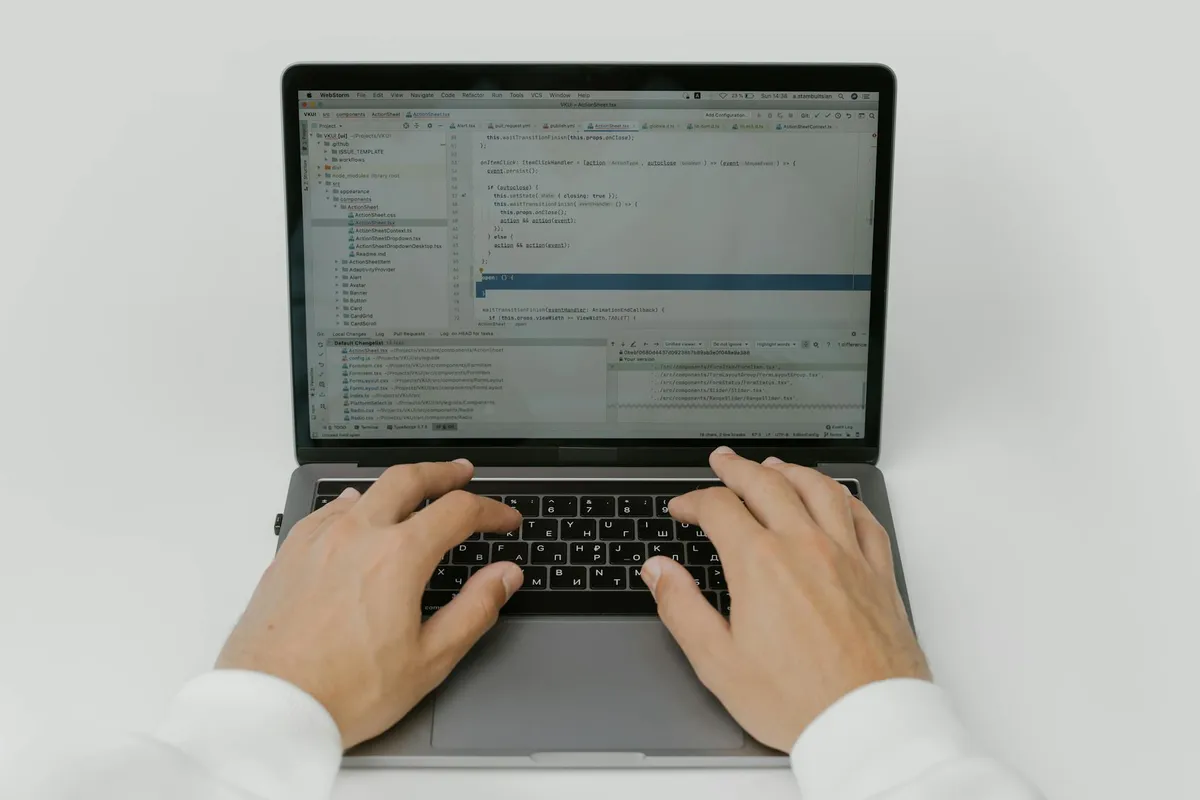
The term "vibe coding" was coined in 2025 by Andrej Karpathy, OpenAI co-founder, to describe a new development approach: you describe what you want in natural language, an AI model generates the code, you review and iterate. Collins Dictionary named vibe coding its "Word of the Year 2025." By 2026, it has become mainstream, 92% of US developers use AI coding tools daily, and 87% of Fortune 500 companies have adopted at least one vibe coding platform.
This isn't a trend to track anymore. It's an operational reality that's reshaping team expectations, hiring profiles, and the competitive dynamics of software projects. For Moroccan CTOs and startup founders, here's the complete guide to understanding what's happening, and how to benefit from it without absorbing the risks.
The problem vibe coding solves (and the ones it creates)
Why it's become unavoidable
The productivity gains measured by independent studies are real and meaningful. Research published in 2026 shows a 26% improvement in overall task completion speed for teams adopting a structured vibe coding approach. For specific tasks, API integration, boilerplate generation, standard CRUD operations, time savings reach 81%. And 74% of developers report increased productivity.
In concrete terms: features that took two weeks now take five days. Bugs that required two hours of debugging get diagnosed in twenty minutes. Proof-of-concepts that previously stalled on technical complexity are now buildable by non-technical product teams.
For Moroccan startups and SMEs operating with limited resources, this is a real shift in leverage: it's now possible to build competitive software products with smaller teams.
The flip side: documented risks
The 2026 data is equally honest about the risks. A CodeRabbit analysis of 470 open-source pull requests (December 2025) found that AI co-authored code contains on average 1.7 times more "major" issues than fully human-written code. Specifically:
- Configuration errors are 75% more frequent in AI-generated code
- Security vulnerabilities are 2.74 times more common
- Logic errors (incorrect dependencies, flawed control flow) are significantly elevated
The consensus from 2026 practitioners is clear: "The differentiator won't be whether teams use vibe coding, but how explicitly they manage its failure modes." This isn't a fire-and-forget tool, it amplifies human capabilities when used well, and amplifies human errors when it isn't.
How vibe coding works in practice
This isn't a single tool but a set of practices and tools covering different parts of the development cycle.
The AI coding tools landscape in 2026
Three main categories of vibe coding tools exist:
Contextual auto-completion (GitHub Copilot, Continue, Codeium): These integrate directly into existing IDEs and suggest code lines or blocks in real time based on context. They're the least disruptive to existing workflows and have the broadest adoption. Copilot, the most widespread, now contributes to approximately 42% of all committed code in projects where it's active.
AI-native IDEs (Cursor, Windsurf): These editors were built around AI rather than retrofitted for it. Cursor in particular enables "composer" sessions where a developer describes a feature in natural language and the AI creates or modifies multiple files in a single interaction. For greenfield projects or large-scale refactoring, the acceleration is dramatic.
Development agents (Claude Code, Devin, OpenAI Codex CLI): These agents can handle end-to-end development tasks, reading the codebase, writing tests, fixing bugs, deploying changes, with minimal human supervision. They represent the most advanced frontier of vibe coding and also require the most organizational maturity to use correctly.
The workflow that actually works
Teams getting the most from vibe coding have converged on a structured workflow in 2026:
Step 1: Precise task definition. The AI is only as good as your prompt. Before asking Cursor or Claude Code to "create a checkout page," a mature team spends 15 minutes drafting a precise brief: which components, which edge cases, what business logic, what technical constraints. Time invested here determines 80% of the output quality.
Step 2: Generation and critical review. The AI generates code, quickly. Your senior developer doesn't merge blindly. They review with two questions: "Does this do exactly what I described?" and "Do I understand every line of this code?" If either answer is no, you iterate.
Step 3: Mandatory testing. AI-generated code is more susceptible to subtle logic errors and security issues. Teams that don't suffer from the documented risks are the ones that made automated testing non-negotiable, the AI can generate these tests itself, increasing coverage without additional manual effort.
Step 4: Documentation and attribution. Undocumented code becomes unreadable quickly, particularly when a significant portion was AI-generated. 2026 best practices include systematically noting which parts of the code were generated and by which tool, to facilitate future audits and maintenance.
What vibe coding changes for your hiring and organization
The developer profile is evolving
Senior developers (10+ years experience) report productivity gains up to 81% with vibe coding, they use AI to delegate routine tasks and focus on architecture, critical decisions, and code review. Their value increases.
Junior developers have mixed results: 40% admit to deploying code without fully understanding it. This is the risky scenario, and it largely explains the security vulnerability statistics. Investing in training for critical code review and security best practices has become essential for juniors using AI tools.
Non-technical profiles are becoming contributors
One of the least anticipated shifts from vibe coding: product, design, and business-domain profiles can now build functional prototypes and internal tools without formal programming training. For early-stage startups or SMEs hesitant to hire full-time developers, this creates a real opportunity to test product hypotheses without the associated costs.
New required skill: code prompt engineering
Formulating precise instructions to an AI model has become a technical skill in its own right. The most effective teams in 2026 have developers who master both code and structured prompt writing. It's a skill that's relatively fast to develop but makes a measurable difference in output quality.
Implementation guide for a Moroccan team
Phase 1: Structured experimentation (months 1–2)
Start with a single tool and a single well-scoped project. GitHub Copilot or Cursor are the most natural entry points for a team just getting started. Set clear rules: what level of review is expected, which tasks are appropriate for AI delegation, and how generated code should be documented.
During this phase, measure. How long did a similar user story take before? How long does it take now? How many bugs were introduced vs. caught in review? Your own team's data is more reliable than generic industry studies.
Phase 2: Workflow standardization (months 3–4)
Once you have first-hand experience, formalize the practices that worked into team protocols. This includes: "ready to merge" criteria for AI-generated code, prompt templates for recurring tasks (API endpoint generation, test writing, refactoring), and security checkpoints specific to AI code.
Phase 3: Extension to agents (month 5+)
Development agents like Claude Code enable delegation of longer, more complex tasks, codebase audits, regression test generation, database migrations. This phase requires greater maturity in code review and governance, but the productivity gains are proportionally larger.
Our team provides development services and AI automation support for these transitions. For companies that want to integrate vibe coding into their stack without introducing compounding technical risks, we can audit your current setup and recommend a tailored approach.
For teams looking for a detailed comparison of the AI coding tools already available on the market, our Cursor vs GitHub Copilot vs Continue comparison for Moroccan teams covers the IDE-level options in depth.
Key numbers to remember
Before deciding on your vibe coding posture, here are the essential data points from 2026 studies:
Productivity really improves, 26% average improvement in overall task completion, up to 81% on specific repetitive tasks.
But the risks are real, AI-generated code contains 1.7x more major issues than human code, and 2.74x more security vulnerabilities without structured review.
Experience level determines gains, senior developers average 81% productivity improvement; junior developers have mixed results.
Testing is the only real guardrail, teams that maintain rigorous test coverage neutralize the majority of risks from AI-generated code.
Adoption is now an industry standard, 92% of US developers, 87% of Fortune 500. Choosing not to adopt these tools has an increasing competitive cost.
Related Resources
Comparing providers? Check out our detailed comparison:
FAQ
Is vibe coding right for all project types? No. The gains are greatest for repetitive tasks, greenfield projects, and standard API integration. For critical systems (medical, financial, infrastructure), adoption should be gradual and paired with strict review protocols. Projects requiring very complex or proprietary business logic benefit less from automatic generation.
How do we handle intellectual property in AI-generated code? This is a legal question still evolving in 2026. Recommended practice: systematically document which parts of your code were AI-generated, review your tool's terms of service (Copilot has a filter mode for copyleft licenses), and consult your legal team for critical commercial projects.
Do we need to change our hiring process? Yes, progressively. Technical interviews that test syntax memorization or standard algorithmic problem-solving become less relevant. Skills gaining importance: the ability to critically review code, identify logic errors, write precise prompts, and make architecture decisions. These require different testing approaches.
What budget should we plan for these tools? GitHub Copilot costs approximately $19/month per developer. Cursor Pro is $20/month. Claude Code is usage-based (typically $50–200/month for intensive use). For a 5-developer team, tool costs represent under 10% of salary spend, and the ROI calculated on productivity gains is typically positive within the first month.
Will clients or partners accept AI-generated code? This is a legitimate concern in some sectors. The answer is to treat vibe coding like any other development tool: what matters is the quality of the delivered, documented, and tested code, not the generation method. Be transparent with clients in contracts if the question arises, and ensure your review process delivers guarantees equivalent to fully human-written code.