
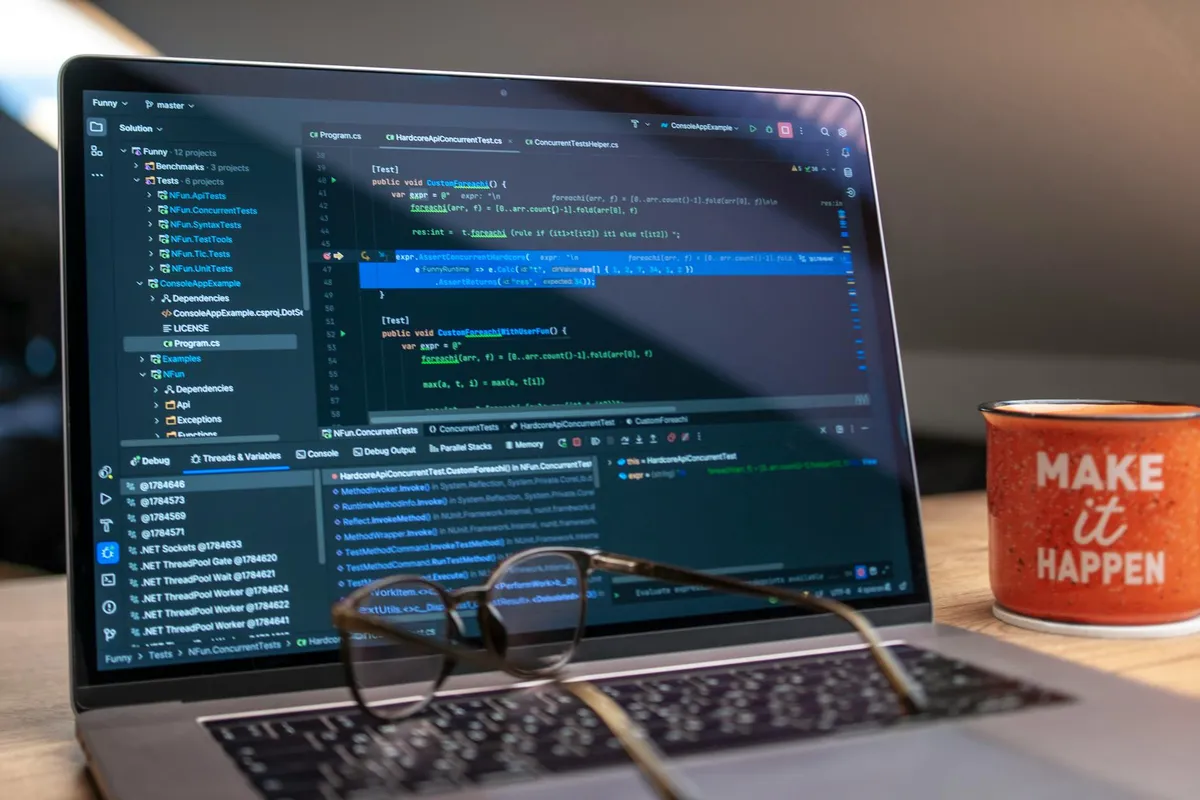
Your business has unique needs. No surprise there, every organization has its own processes, customers, and constraints. The question isn't whether generic software can accommodate them, it's whether it will do so well enough not to hold back your growth.
More and more Moroccan businesses are reaching the same conclusion: off-the-shelf solutions (monolithic ERPs, standard management software) offer 80% of what they need, but it's often that missing 20% that generates the most operational friction and the majority of productivity losses. According to Gartner (2024), 65% of businesses that invest in custom tools report a measurable competitive advantage within 24 months of deployment.
This guide is the most comprehensive resource on web development in Morocco. It covers the choice between standard and custom solutions, the development process, costs, framework selection, security, hosting, e-commerce, multilingual support, and everything a decision-maker needs to know to successfully lead a digital project.
Off-the-Shelf vs. Custom Software: How to Choose
| Criteria | Custom Application | Off-the-Shelf Software | Generic ERP |
|---|---|---|---|
| Business fit | Total | Limited | Partial |
| Initial cost | MAD 80,000–500,000 | MAD 5,000–30,000 | MAD 50,000–300,000 |
| Deployment time | 8–24 weeks | 1–4 weeks | 12–36 weeks |
| Scalability | Total | Vendor-dependent | Limited to modules |
| Maintenance cost | Controlled | Recurring licenses | Licenses + integrator |
The first question isn't "which technology?", it's "how much customization do I actually need?"
Choose off-the-shelf software if:
- Your need is generic (standard accounting, basic HR management)
- Your process can adapt to the software without too much friction
- Budget is limited and speed of deployment is the priority
- A mature solution exists with a solid user base
Choose custom development if:
- Your process is unique and constitutes a competitive advantage
- You need to integrate multiple existing systems smoothly
- No standard solution covers more than 70% of your needs
- You're expecting strong growth that will require specific scalability
- Data confidentiality or security is critical
In practice, most projects we work on combine both: a standard ERP (Odoo, SAP) at the core, with custom modules built on top for differentiating processes.
A slow or outdated website can negate all the advantages of a well-built business application. If you suspect your current site is holding back your growth, read our article Is your slow website killing your growth? to diagnose the problem.
Types of Applications We Build in Morocco
Enterprise Web Applications
Browser-based applications, cloud-hosted, used by your internal teams or clients. They cover the majority of B2B use cases:
- Client portals and account management spaces
- Management dashboards and interactive reporting tools
- Ticketing and project management systems
- Contract and document management platforms
- Custom CRM and sales pipeline applications
Advantages: accessible from any device, easy to update, no installation required on the user side.
Mobile Applications (iOS and Android)
Essential for field operations:
- Sales force applications (order taking, field reporting)
- Logistics and delivery management tools
- Quality control and maintenance applications
- Customer mobile portals (order tracking, communication)
Our approach: We prefer cross-platform development (React Native, Flutter), delivering iOS and Android from a single codebase, reducing development costs by 40 to 60%.
SaaS Platforms
For companies that want to not only digitize their own operations but also commercialize software to others:
- Multi-tenant architecture design
- Subscription billing systems
- Analytics dashboards for end clients
- Third-party integration APIs
Integrations and Connectors
Often underestimated, integrations between existing systems deliver considerable value:
- ERP ↔ CRM ↔ E-commerce connectivity
- Workflow automation between tools (HubSpot, Zoho, Sage, etc.)
- Public APIs for partners and resellers
- Integration with Moroccan payment gateways (CMI, PayZone, etc.)
The Development Process: What Actually Happens
Step 1: Discovery and Specifications (2–4 Weeks)
Before writing a line of code, we take time to understand:
- Your business, your processes, your users
- Must-have vs. nice-to-have features
- Technical constraints (existing systems to integrate)
- Budget and timeline
Deliverable: a functional specification document, wireframe (low-fidelity mockup), and detailed estimate.
Important: never skip this step to "save time." Poor scoping is the primary cause of budget overruns in IT projects.
Step 2: UX/UI Design (2–3 Weeks)
User experience determines adoption. A technically flawless application that's difficult to use will be abandoned. We design interfaces that:
- Reflect your brand identity
- Are intuitive for your target users
- Work seamlessly on mobile and desktop
- Are accessible even for less tech-savvy users
Deliverable: high-fidelity mockups (clickable designs) validated by your team before any development begins.
Step 3: Agile Development (2–6 Months Depending on Complexity)
We work in 2-week sprints. At the end of each sprint, you see a working version of the application, not a PowerPoint, a real testable product.
Advantages of this approach:
- You can adjust priorities mid-project
- Problems are detected early, before they become expensive to fix
- You have permanent visibility into progress
- The final product genuinely matches your expectations
Our technology stack: Next.js / React for the frontend, Node.js or Python for the backend, PostgreSQL or MongoDB for databases, AWS or Vercel for hosting.
Step 4: Testing and QA (2–3 Weeks)
Before going live, we conduct thorough testing:
- Functional tests: every feature behaves as expected
- Performance tests: the application handles the expected load
- Security tests: no exploitable vulnerabilities
- User tests: real users test the application
Step 5: Deployment and Training (1–2 Weeks)
Launch is a critical phase. We handle:
- Progressive rollout (blue-green deployment)
- Data migration from existing systems
- Training for end users and administrators
- Enhanced support during the first weeks
Step 6: Maintenance and Evolution (Ongoing)
An application is never "finished." We offer maintenance contracts that include:
- Bug fixes guaranteed within 24 to 48 hours
- Security updates
- Planned feature evolutions
- Availability and performance monitoring
How Much Does Custom Development Cost in Morocco?
This is the question everyone asks, and rightfully so. Here are realistic ranges based on our project experience:
| Project Type | Duration | Price Range |
|---|---|---|
| Simple web application (5–10 screens) | 2–3 months | MAD 80,000 – 150,000 |
| Web application with integrations | 3–5 months | MAD 150,000 – 350,000 |
| Complete SaaS platform | 5–9 months | MAD 350,000 – 800,000 |
| Cross-platform mobile application | 3–5 months | MAD 120,000 – 300,000 |
These ranges include: UX/UI design, development, testing, deployment, and 3 months of post-launch support.
What drives cost:
- Functional complexity (number of user roles, business rules, integrations)
- UX/UI design quality desired
- Data volume and performance requirements
- Security level required (ISO certifications, CNDP compliance)
The cost of custom development is just one component of your overall digital budget. For a comprehensive view of website creation costs in Morocco, including brochure sites, landing pages, and e-commerce stores, read our complete guide to website pricing in Morocco. It breaks down price ranges by project type, factors that influence quotes, and pitfalls to avoid when comparing proposals.
How to Optimize Your Development Budget
A few proven strategies to maximize return on investment:
1. Launch an MVP (Minimum Viable Product). Rather than building every feature at once, identify the 3 to 5 critical features and launch with those. You collect real user feedback before investing further.
2. Prioritize ruthlessly. The MoSCoW matrix (Must, Should, Could, Won't) is your best tool. Every "nice-to-have" feature added to the initial scope delays launch and increases risk.
3. Invest in the discovery phase. A 2- to 3-week scoping sprint costs between MAD 15,000 and 30,000. It stabilizes the specification, identifies technical risks, and locks in a fixed price for development. Without scoping, initial estimates can drift by 30 to 100%.
4. Reuse existing components. There's no need to code everything from scratch. Authentication systems, admin interfaces, notification engines, all of these exist as mature, battle-tested libraries.
Related Resources
Explore our solutions tailored to your needs:
Comparing providers? Check out our detailed comparison:
Related reading
Next.js vs WordPress: Which Framework to Choose?
The framework choice is a structural decision for any digital project. Two options dominate the Moroccan market: WordPress, the legacy CMS that powers over 40% of the global web, and Next.js, the modern React framework that's attracting more and more performance-focused businesses.
WordPress remains relevant for simple brochure sites, blogs, and small e-commerce stores. Its plugin ecosystem is massive, and you'll easily find WordPress developers in Morocco. But it shows its limits as soon as needs become complex: degraded performance under load, security that depends on constant plugin updates, and a monolithic architecture that's difficult to evolve.
Next.js offers natively superior performance through server-side rendering (SSR), static site generation (SSG), and automatic code splitting. Next.js sites consistently achieve better Core Web Vitals scores, which translates to better Google rankings and better user experience. For business applications, dashboards, and SaaS platforms, Next.js is the clear winner.
Our recommendation: for a 5- to 10-page brochure site with no specific technical requirements, WordPress can suffice. For everything else, high-traffic sites, business applications, platforms with authentication, performant multilingual sites, Next.js is superior on every metric that matters.
For a detailed comparison with real benchmarks, concrete use cases, and a decision matrix, read our guide Next.js vs WordPress: which choice for your Moroccan business?.
PWA vs Native App: The Right Choice for Mobile
The question "should we build a mobile app?" comes up in virtually every project. But behind this simple question lies an important technical choice: native app, hybrid app, or Progressive Web App (PWA)?
Native Apps (Swift for iOS, Kotlin for Android)
The traditional choice. You develop two separate applications, one for each platform. Performance is optimal, access to phone features (camera, GPS, push notifications, NFC) is complete, and the user experience is as good as it gets.
The downside: cost. Two codebases mean two development teams, two maintenance cycles, and costs that double or triple compared to a single solution.
Hybrid Apps (React Native, Flutter)
An intelligent compromise. You write a single codebase that runs on both iOS and Android. Performance is close to native (90 to 95% in the majority of use cases), access to phone features is good, and costs are reduced by 40 to 60%.
Ideal for: business applications, customer mobile portals, field tools, and the majority of B2B use cases.
Progressive Web Apps (PWA)
A PWA is essentially a website that behaves like a mobile app. It works offline, can send push notifications, and installs on the home screen without going through the App Store or Google Play.
Decisive advantages: no Apple/Google commission (15 to 30%), no App Store review process, a single codebase for web and mobile, instant updates without requiring users to download anything.
Ideal for: e-commerce applications, service portals, product catalogs, and any use case where installation friction is a barrier.
For a comprehensive analysis with decision criteria by project type and performance benchmarks, read our guide PWA vs native vs hybrid apps in Morocco.
Website Redesign: When and Why?
Sometimes, custom development doesn't start from scratch. Many of our clients come to us with an existing site that no longer meets their needs. The question is: should you fix the existing site or rebuild on new foundations?
Signs That a Redesign Is Necessary
Degraded performance. If your site takes more than 3 seconds to load, you're losing 53% of your mobile visitors (Google, 2024). Slow sites don't just frustrate users, they are actively penalized by Google in search results.
Outdated design. A design that made sense in 2020 can look dated by 2026. Beyond aesthetics, usability standards evolve. If your site isn't responsive (mobile-adapted), you're excluding over 70% of Moroccan users who primarily browse on smartphones.
Limiting technical architecture. You want to add a client portal, an online booking system, or a CRM integration, but your current site (often a WordPress with numerous plugins) makes these evolutions expensive or impossible.
Compromised security. Outdated plugins, an obsolete CMS, known vulnerabilities left unpatched, these problems are invisible to the naked eye but expose your business to significant legal and reputational risks.
Declining conversion rates. If your traffic is stable but your conversions are falling, it's often a sign that the user experience no longer meets market expectations.
A well-executed redesign isn't an expense, it's an investment that can be measured in recovered traffic, improved conversions, and gained productivity. To find out whether your site needs a redesign and how to plan it, read our guide Signs it's time to redesign your website in Morocco.
Security and Maintenance: Protecting Your Investment
Custom development represents a significant investment. Neglecting security and maintenance after launch is like building a house without insurance: everything is fine until the first incident.
Web Security in Morocco: A Growing Concern
Morocco is not immune to cybercrime. Web attacks targeting Moroccan businesses are on a constant rise, with consequences ranging from customer data theft to complete operational shutdown.
The most common threats:
- SQL Injection: an attacker inserts malicious code into your forms to access your database. This is the cause of the majority of data breaches.
- Cross-Site Scripting (XSS): malicious code is injected into pages viewed by your users, enabling session hijacking and personal data theft.
- Brute force attacks: bots attempt thousands of password combinations on your login pages.
- DDoS (Distributed Denial of Service): your site is overwhelmed with artificial traffic, making it inaccessible to real customers.
- Dependency vulnerabilities: third-party libraries your application uses contain known flaws that haven't been patched.
Security best practices we follow:
- Multi-factor authentication (MFA) on all sensitive access points
- Data encryption in transit (TLS 1.3) and at rest (AES-256)
- Security-focused code reviews at every sprint
- Penetration testing before launch and quarterly in production
- CNDP compliance (Morocco's data protection authority) for personal data management
- Real-time intrusion attempt monitoring
- Documented and tested incident response plan
For a comprehensive guide to web security practices adapted to the Moroccan context, read our article Web security in Morocco: the essential guide.
Maintenance: The Budget Nobody Plans For
Too many businesses invest in development but forget to budget for maintenance. The result: 6 months after launch, the application accumulates unfixed bugs, unpatched security vulnerabilities, and features that no longer match evolving needs.
What a well-structured maintenance contract covers:
- Corrective maintenance: fixing bugs reported by users, with clear SLAs (service level agreements), for example, critical bugs fixed in 4 hours, minor bugs in 48 hours.
- Preventive maintenance: dependency updates, security patches, performance optimizations, proactive monitoring.
- Evolutionary maintenance: adding new features, adapting to process changes, integrating new tools.
- Monitoring and alerts: 24/7 monitoring of availability, response times, and application errors.
Budget benchmark: plan for 15 to 20% of the initial development cost per year for comprehensive maintenance. For a MAD 300,000 application, that means MAD 45,000 to 60,000 per year, or MAD 3,750 to 5,000 per month.
For a detailed understanding of what a maintenance contract should include and how to negotiate one, read our guide Website maintenance in Morocco: what you need to know.
Web Hosting in Morocco: Where to Deploy Your Application
Hosting is the invisible foundation of any web application. A poor hosting choice can negate all development efforts: slow load times, frequent downtime, and security issues.
Hosting Options for Custom Applications
Shared hosting. The cheapest option (MAD 50 to 200/month) but also the least performant. Your application shares a server with hundreds of other sites. Acceptable for a simple brochure site, unsuitable for a business application.
VPS (Virtual Private Server). A good middle ground (MAD 200 to 1,000/month). You get dedicated resources and full control over server configuration. Suitable for moderate-traffic applications.
Cloud (AWS, Google Cloud, Azure). The professional solution. Automatic scaling (your server adapts to load), high availability (geographic redundancy), and managed services (databases, CDN, monitoring). Cost varies by consumption: from MAD 500/month for a small application to several thousand for a high-traffic platform.
Local hosting in Morocco. For businesses subject to data sovereignty constraints (banking sector, public administration), local providers like Maroc Telecom or Inwi offer hosting solutions with data centers on Moroccan territory.
Critical Selection Factors
- Latency: for a primarily Moroccan audience, a server in Europe (France, Germany) provides good performance. A CDN (Cloudflare, AWS CloudFront) further reduces latency.
- Availability (SLA): aim for a minimum 99.9% SLA, which corresponds to approximately 8 hours of downtime per year.
- Backups: verify the frequency of automatic backups and retention duration. Regularly test restoration.
- Support: responsive technical support in French or Arabic is a significant advantage during critical incidents.
For a detailed comparison of hosting solutions available in Morocco with recommendations by project type, read our complete guide to web hosting in Morocco.
E-Commerce: Shopify vs WooCommerce vs Custom
E-commerce is one of the fastest-growing development segments in Morocco. The Moroccan e-commerce market exceeds MAD 17 billion in 2025, and this trend is accelerating. The question for businesses that want to sell online: which platform to choose?
Shopify: Simplicity First
Shopify is an all-in-one SaaS platform. You pay a monthly subscription (starting around MAD 300/month) and get a functional e-commerce site in a few days. It's the ideal choice for small merchants who want to launch quickly.
Advantages: ease of use, included hosting, managed security, large catalog of themes and apps.
Limitations: limited customization, transaction commissions (on top of payment gateway fees), integration with Moroccan payment gateways can be complex, total vendor dependency.
WooCommerce: WordPress Flexibility
WooCommerce is a free WordPress plugin that turns a site into an online store. It offers more flexibility than Shopify, with full control over hosting and code.
Advantages: no sales commissions, extensive customization via plugins, large community and online resources.
Limitations: requires performant hosting, security is self-managed, performance can degrade with plugin count, technical maintenance required.
Custom E-Commerce: Total Control
For businesses with specific needs (catalogs of thousands of products, complex pricing logic, advanced ERP integrations, multi-vendor marketplaces), a custom e-commerce solution offers total control.
Advantages: optimized performance, native integrations with your existing systems, UX designed entirely for your audience, no third-party commissions.
Limitations: higher initial cost, longer development timeline, requires a technical team for maintenance.
For a detailed comparison with concrete use cases and a decision matrix, read our guide Shopify vs WooCommerce vs custom e-commerce in Morocco.
Multilingual Websites in Morocco: A Business Imperative
Morocco is multilingual by nature. Arabic, French, Amazigh, English, Moroccan businesses operate in a complex linguistic context. A website that only speaks French ignores a significant portion of its potential audience.
Why Multilingual Is Strategic
For the local market: 30% of Google searches in Morocco are in Arabic. If your site only exists in French, you're invisible to this audience. Moreover, Arabic support (RTL, right-to-left) is a technical challenge that few Moroccan sites handle correctly.
For export: if you're targeting European, Anglophone African, or Gulf markets, English and Arabic are essential. A well-optimized multilingual site gives you access to exponentially larger markets.
For SEO: Google treats each language version as a distinct page. A well-structured 3-language site (with correct hreflang tags) mechanically multiplies your search visibility.
Technical Challenges of Multilingual
- URL architecture: subdomains (fr.mysite.com), subdirectories (/fr/), or separate domains (mysite.fr, mysite.com), each approach has its SEO pros and cons.
- RTL support: Arabic reads right-to-left, requiring an entirely mirrored layout. It's not just "translating text", it's rethinking the entire interface.
- Content management: how to manage translations efficiently? Headless CMS with translation workflows? Static translation files? The answer depends on how frequently content is updated.
- Multilingual SEO: hreflang tags, per-language sitemaps, translated meta descriptions, localized structured data, multilingual SEO is a technical discipline in its own right.
For a complete technical and strategic guide to building a multilingual website in Morocco, read our article Multilingual websites in Morocco: the complete guide.
How to Choose Your Web Development Agency in Morocco
Choosing the right partner is as critical as choosing the right technology. An excellent specification handed to the wrong agency will produce a mediocre result. Conversely, a good agency will challenge your specifications and propose better solutions.
Essential Selection Criteria
1. Business understanding. An agency that codes fast but doesn't understand your business will deliver a technically correct but functionally inadequate product. Look for a partner who asks pertinent questions about your operations, not just your technical specifications.
2. Portfolio and references. Ask to see projects similar to yours, not the most impressive, the most comparable. Contact reference clients and ask the question that matters: "Would you work with them again? Yes or no, and why?"
3. Process transparency. A serious agency will clearly explain its development process, testing methods, and project management practices. If an agency can't explain how it works, that's a red flag.
4. Team stability. Turnover is the bane of web agencies in Morocco. A developer who leaves the agency mid-project takes the knowledge of your system with them. Ask about the average tenure of the technical team.
5. Pricing model. Fixed price, time-and-materials, or hybrid? Each model has its advantages:
- Fixed price: you know the total cost upfront, but the scope must be perfectly defined.
- Time-and-materials: more flexible, suited for exploratory projects, but risk of budget drift.
- Hybrid: fixed price for initial development + time-and-materials for evolutions. This is often the most appropriate model.
6. Code ownership. Verify contractually that the source code belongs to you upon delivery. Some agencies retain ownership and charge you to access it, a practice to avoid absolutely.
Red Flags
- A firm quote without a prior scoping phase
- Inability to provide verifiable references
- Unrealistic timelines ("we'll deliver this in 3 weeks" for a complex project)
- No structured methodology (no agile, no sprints, no regular demos)
- A price significantly below market (custom development has incompressible costs)
For a complete evaluation framework with interview questions and scoring criteria, read our guide How to choose your web agency in Morocco.
Common Mistakes to Avoid
Under-specifying upfront. "We'll figure it out as we go" is the most expensive phrase in software development. The later a change comes in a project, the more expensive it is to implement.
Choosing solely on price. A very low quote often hides junior developers, lack of documentation, or no testing. The real cost shows up in maintenance and bug fixes.
Neglecting security. Web attacks are rising in Morocco as everywhere else. Budget for security testing from day one.
Not involving users. Applications that nobody uses are the most common IT waste. Have real users test your application from the wireframe stage.
Forgetting maintenance. Planning a development budget without a post-launch maintenance budget is like buying a car without planning for fuel.
Ignoring mobile. In 2026, over 75% of web traffic in Morocco comes from smartphones. If your application isn't optimized for mobile, you're losing the majority of your potential users.
Neglecting SEO from the start. Search optimization isn't bolted on after the fact, it's built into the very architecture of the application. URL structure, load speed, semantic markup, structured data: all of this must be planned during the development phase.
Why Choose Claro Digital for Your Project
We are a development and design team based in Morocco that understands local realities: existing systems common in the market, local payment integrations, common third-party tools, and the project management culture of Moroccan enterprises.
We've delivered over 30 projects for clients across real estate, finance, consulting, e-commerce, and healthcare. Our client satisfaction rate is 5/5.
Our commitments:
- Full transparency on costs and timelines
- Permanent access to your source code
- Intellectual property belongs to the client
- 24/7 support during the launch period
Our expertise covers the entire chain: from web development to production deployment, including UX/UI design and SEO. Whether you need a business application, an e-commerce platform, or a high-performance brochure site, we have the skills and experience to turn your vision into reality.
FAQ
What's the difference between custom development and off-the-shelf software? Off-the-shelf software (ERP, CRM, SaaS tools) is designed to fit as many businesses as possible by covering the most common use cases. A custom application is built for your specific business processes, where your competitive advantage lies.
Custom development is relevant when your competitive advantage depends on processes that standard tools can't model, or when the friction generated by generic tool compromises costs more than building a tailored solution.
How much does a custom application cost in Morocco? Projects we deliver range from MAD 80,000 for a focused internal tool (management portal, analytics dashboard, smart forms) to over MAD 800,000 for complex platforms (marketplace, multi-tenant SaaS, multi-source integration system). A fixed price is possible after a 2- to 3-week scoping sprint that stabilizes the specification. Without scoping, initial estimates are orders of magnitude, not commitments.
How long does it take to build a custom application? End-to-end projects take between 2 and 9 months depending on complexity. A simple internal tool: 8 to 12 weeks. A web application with authentication, roles, and dashboard: 3 to 5 months. A SaaS platform or iOS + Android mobile application: 6 to 9 months. What extends timelines: specifications that change during development, integrations with poorly documented third-party systems, and long internal validation cycles on the client side.
Who owns the code after the project? You do. The entirety of the source code produced during the project belongs to you upon final delivery. We document the code and organize knowledge transfer to your technical team. If you want to evolve the application with a different team, you have access to everything. We also offer a maintenance contract for security updates and feature evolutions, but it's not mandatory.
How do I choose a development partner in Morocco? Evaluate four criteria: the ability to understand your business (not just code), transparency on timelines and costs (beware of quotes without scoping), quality of past work (ask to speak with clients your size), and team stability (high turnover = risks for your project). A good partner will propose a paid scoping sprint before committing to a fixed price, that's a sign of process maturity, not reluctance to commit. For more detail, read our guide to choosing a web agency in Morocco.
What's the best technology for my project? There's no universal answer, but there is a clear decision framework. For simple brochure sites, WordPress remains viable. For business applications, SaaS platforms, and high-performance sites, Next.js is the best choice in 2026. For mobile, hybrid solutions (React Native, Flutter) or PWAs cover 90% of use cases at a significantly lower cost than native. The choice depends on your budget constraints, timeline, and specific functional requirements.
How do I ensure my application is secure? Security isn't a feature you add after the fact, it's a continuous practice that starts at design. The fundamentals: strong authentication, data encryption, regular penetration testing, dependency updates, CNDP compliance for personal data, and an incident response plan. We integrate these practices into our standard development process. For more detail, read our web security guide for Morocco.
Have a project in mind? Request a free quote, response within 48 hours with a detailed initial estimate.